The Baths of Beppu
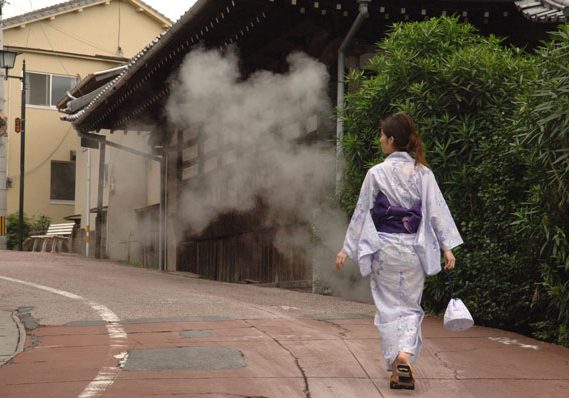
Wherever I look from the train window, I see a Japanese landscape. In the foreground are workers hunched over in rice paddies, and in the background is the snow-capped peak of Mt, Fuji. It’s a sunny, diamond-bright day in May, and I am on the final leg of a six-hour shinkansen (Japanese bullet train) journey from Tokyo to Beppu, the hot springs resort nestled at the base of the Tsurami Mountains on Japan’s southernmost island of Kyushu.
 According to 8th century legend, two gods visiting Beppu create the onsens when one gets sick. This makes the other god sad. So the sad god pulls out a long pipe from the seabed of Bungo and creates an onsen where the sick god can bathe. And the sick god gets well. Today some four million visitors each year make the pilgrimage to this seaside resort to also get well by steaming, boiling or poaching vitality into their travel-weary bodies.
Beppu has many geothermal hot spots, and produces the second largest volume of hot water in the world after Yellowstone National Park. It has the largest number of hot springs in Japan (more than 3,000), ranging from traditional hot spring ofuros to steamy gray-mud doroyus to hot sand sunaysa. My first destination is the oldest spa, which also happens to be the closest to the train station; the black sand bath at Takegawara.
Community Bath
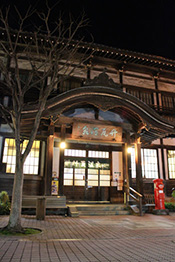
Dating to 1879, Takegawara means “bamboo-roof,” so named because the roof was originally made with bamboo slats. Though the monstrous building is rebuilt, it still retains an old world feel with such traditional Japanese elements as upturned eaves, hanging red lanterns and wooden flower planters.
But this is a community as well as a visitors’ bath, and I walk past bikes and scooters leaning against the wall before entering sliding doors (or shoji) into the bath. Here a woman behind a window takes my yen, and as is the custom, I swap my street shoes for plastic slippers to flip-flop across the wood floor. The inside is reminiscent of an old gymnasium with high wooden ceilings and brick walls. I head to the women’s area where I enter shoji hiding mounds of black sand. The men’s area is behind a rice paper partition and the attendants scurry from one room to the next.
My destination is a cozy furrow with a folded towel at one end to serve as a pillow. After crawling into the furrow, I’m quickly immersed in hot black sand, and I savor the warmth as it coaxes away tension and frustration and flushes impurities from my body. The waters contain a healing substance used in treating rheumatism, neuralgia and other diseases.
After ten minutes, the attendant signals me to emerge and rinse in a canal of water rimming the wall. That’s followed by a warm shower and a luxurious soak in a hot lemon-scented pool. I have a small towel to protect sensitive body parts and that same little towel is rinsed by the attendant and set nearby. It services as my chamois: I dry off, I wring it out and I dry again. I am slow to get dressed, still savoring the revitalizing effect of the hot sand.
 Into the Mud
Energized, my next stop is a doroyu or mud bath tucked in the hills above town. The baths are located at Hoyoland Onsen, where you pay to soak in different pools. I start with the traditional hot springs bath.
The procedure for all is the same. Disrobe in the dressing room and store your clothes in a locker or basket. Hold a small towel or washcloth in front of your body and walk to the bath area. There you’ll find a plastic basin, a plastic stool and faucets along the wall. Sit with the other bathers facing the faucet and fill the bucket with water, repeatedly dousing yourself and then soaping down completely, careful to remove all traces of soap before heading for the bath. There are two cardinal sins in Japan. One is not removing your shoes when entering a Japanese home, inn or temple and the other is bringing soap into a Japanese bath.
Too Hot for Comfort
Sometimes the ofuros are too hot for comfort (hot springs are heated to a minimum of 107F), so it helps to ease in gently and then sit perfectly still until your body grows accustomed to the warmth. I bask in the hot bath for several minutes before heading down a flight of slippery, mud-stained stairs into what looks like a converted basement, with cement walls, exposed pipes and a murky pool of pale gray mud freshly pumped form the center of the earth.
The hot mud doesn’t circulate well, so bathers move carefully until they find a comfortable spot. Move one direction and the mud is tepid, move the other direction and you’re in mire so hot it burns.
A sign on the wall tells me to scrape the mud from my body and shower before heading upstairs to a series of coed roten buro. These are open-air baths sprinkled throughout a courtyard landscaped with potted palm trees.
Coed baths are not for the modest, though etiquette dictates carrying a small cloth to cover private parts when moving from one pool to the next.
Soaking in Fruit
I linger in the outdoor bath, until it is time to dress and head to the Myoban onsen, where whole oranges, lemons and grapefruit float in outdoor baths. The tradition here is to visit the spas but also to visit the shops and huts and browse the array of yunohana (sulfuric powder) extracted from the water and sold for home use as dried bath minerals and sulfur flakes.
Of the many onsens in Beppu, the hillside Suginoi Hotel is probably the most impressive. At one time an enormous gilt-covered Oyakushi-sama (the Buddha who gives medicine to the ill) loomed atop a giant fish bowl of carpe in one bath and a red torii gate, similar to the ones found at Shinto shrines, the focus of another. Today the hotel boasts several levels of rooftop pools, many with breathtaking views of the water.
Peaceful Setting
For a peaceful setting, try the sunayu seaside baths at Beppu Bay. These steamy beds of sand near the harbor cove overlook the blue water of the inlet. Umbrellas provide protection from the sun, and picnic tables offer a place for a relaxing lunch after bathing.
The rule is no more than three baths a day so I will save the sand baths for tomorrow. Today, I have been poached, boiled and steamed enough and am ready to crawl into the comfort of my ryokan bed.
–Rose